
An Essay by Tahyira Savanna for #BlackLivesMatter
The reality of white supremacy in the United States has long been anchored by an obsessive fixation on the control, containment, and ultimate destruction of the Black body. In academic discourse, the deliberate use of the term “Black body”—pioneered by thinkers from Ida B. Wells to Ta-Nehisi Coates and philosopher George Yancy—is not a mere rhetorical device; it is a precise diagnostic tool. It illuminates how racist ideology systematically strips Black individuals of their human agency, intellect, and interiority, reducing them to mere physical tissue that must be monitored, mastered, and erased. For centuries, this fixation has manifested as a pathological paradox: the dominant white imagination projects onto the Black body an inherent, monstrous physical threat—rendering it hyper-strong, inherently criminal, or pathologically “insolent”—while simultaneously keeping that body uniquely vulnerable to systemic violence.

This violence is never isolated; it is a continuous historical current. From the brutal mutilation of fourteen-year-old Emmett Till in 1955 to the suspicious 2026 death of eighteen-year-old Nolan Wells in Mississippi, the American landscape remains haunted by a cycle of racial terror. In this cycle, the physical destruction of Black lives is consistently shielded by state-sanctioned institutional indifference and rubber-stamped by judicial processes designed to preserve white hegemony. However, the modern manifestation of this terror does not operate in a vacuum of historical reenactment; it is actively supercharged by a sophisticated 21st-century digital ecosystem.

Today, social media networks like Meta’s platforms (Facebook and Instagram) and TikTok act as the primary vectors for an algorithmic “outrage economy.” By optimizing for engagement above all else, these corporations monetize anti-Black racism, creating a digital pipeline that radicalizes white users under the banner of weaponized grievance. This online normalization of violence does not merely harm Black targets; it fundamentally corrupts the psychological mindset of white consumers. It transforms passive beneficiaries of white privilege into active participants in domestic terror, an entitlement that found its most vivid national expression during the January 6th Capitol insurrection. Ultimately, the mechanics of racial terror have evolved in medium but remained identical in function: the unchecked entitlement that once gathered crowds around a hanging tree now organizes insurrections and sanitizes modern lynchings through a glowing screen.

The Blueprint of Bodily Terror – Emmett Till and the Historic Spectacle
To understand the contemporary landscape of racial violence, one must parse its historical blueprint: the August 1955 lynching of Emmett Till in Money, Mississippi. Till’s murder was the ultimate distillation of the white supremacist obsession with the Black body. The catalyst for his execution was not a crime of property or physical harm, but a perceived violation of racial etiquette—an alleged whistle or “insolent” remark directed toward a white woman, Carolyn Bryant. In the Jim Crow South, the mere presence of a Black male body in proximity to white womanhood was racialized as an existential threat to the social order.
The violence inflicted upon Till by Roy Bryant and J.W. Milam was explicitly visceral, a localized manifestation of a macrocosmic rage. They did not simply execute him; they meticulously dismantled his physical form. They beat him beyond recognition, gouged out his eye, shot him through the head, and tethered his corpse to a seventy-pound cotton gin fan with barbed wire before submerging him in the Tallahatchie River. This level of overkill reflects a profound psychological pathology: a desperate, violent fixation on dominating the physical reality of the Black body to reassure the perpetrator of their own absolute dominance.

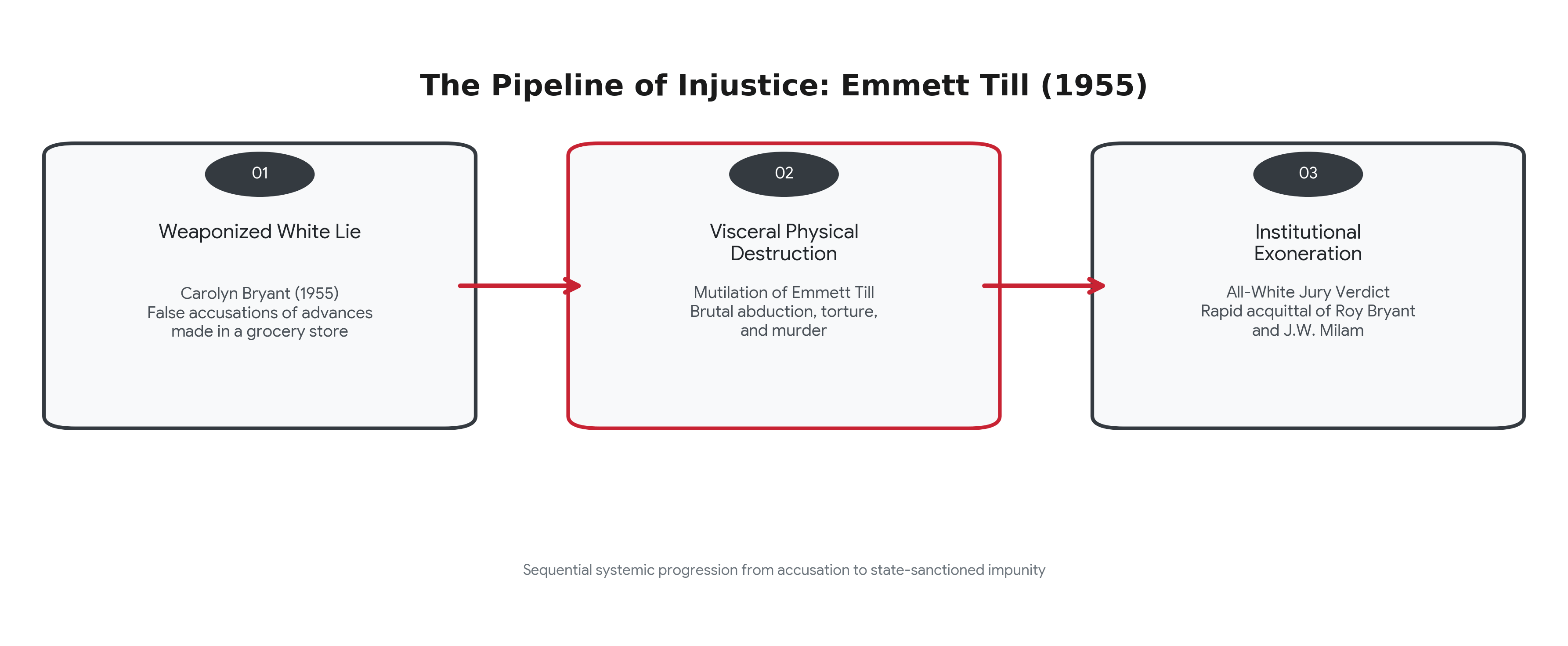
Crucially, this acts as a dual-layered phenomenon. While the perpetrators sought to erase Till’s body, his mother, Mamie Till-Mobley, recognized that the physical evidence of this hatred had to be weaponized in reverse. By demanding an open-casket funeral in Chicago and allowing Jet magazine to photograph her son’s bloated, mutilated face, she forced a local Southern ritual into a global media spectacle. She understood that the only way to combat the systemic erasure of Black humanity was to force the world to look directly at what white supremacy physically does to the Black body.
Yet, despite international outrage, the institutional shield of white privilege functioned perfectly. An all-white, all-male Mississippi jury acquitted Bryant and Milam after just sixty-seven minutes of deliberation—a deliberation so casual that jurors later admitted they stopped to drink soda to pass the time. The state prioritized white solidarity over objective truth, establishing a legal precedent where the destruction of a Black life could be absorbed by the judicial system as a necessary act of social preservation.
Seventy-one years after the murder of Emmett Till, the same Mississippi landscape yielded a hauntingly familiar tragedy, illustrating that the geographical and institutional architectures of racial terror remain fully intact. In March 2026, eighteen-year-old Nolan Wells traveled to Horn Island, Mississippi—an isolated barrier island in the Gulf of Mexico—with a group of white acquaintances. He never returned alive. His body was recovered from the water days later, initiating a chain of events that directly mirrors the historical trajectory of the Jim Crow era, updated for the modern age.
The structural parallels between the Till and Wells cases are stark, beginning with the racial geography of the event. Wells found himself navigating a deeply isolated, predominantly white space—a physical environment where the protective social buffer of his own community was entirely absent. Following his disappearance, the initial response of local law enforcement was characterized by a familiar rush to closure. Authorities quickly moved to label the tragedy an accidental drowning, a narrative designed to minimize public scrutiny and de-escalate any potential racial tension.
However, forensic evidence quickly collided with this official state narrative. Independent and state autopsies revealed deep, unexplained blunt-force trauma and bruising on the back of Wells’ head. Most damningly, medical examiners noted an absence of water in his lungs and stomach—a clinical reality that strongly contradicts the mechanics of a standard drowning. This medical discrepancy points to a contemporary pattern of forensic erasure: a tendency by local state mechanisms to scrub away or misclassify the physical evidence of trauma on Black bodies in order to avoid investigating racial violence.
Furthermore, the digital artifacts surrounding the case exposed the underlying racial anxieties of the participants. Cellphone forensics later recovered and publicized by civil rights attorney Ben Crump revealed text messages exchanged among the white youth on the island. These communications explicitly detailed an intense, active concern that other individuals present on Horn Island held deeply racist views. Despite these chilling digital warnings and the glaring physical contradictions of the autopsy, a Mississippi grand jury declined to hand down any criminal charges. Just as the court system of 1955 reflexively protected Bryant and Milam, the modern judicial apparatus of 2026 deployed its grand jury mechanism to insulate the survivors from accountability, signaling once again that the state will default to an attitude of institutional indifference when a Black body is destroyed in white spaces.

The underlying mechanics of these platforms are driven by a singular corporate mandate: maximize user engagement to drive advertising revenue. Internal whistleblower disclosures and investigative research have repeatedly demonstrated that algorithms do not favor neutral or factual information; instead, they optimize for content that triggers visceral, negative emotional responses—specifically anger, fear, and moral outrage. Because anti-Black tropes, racial conspiracy theories, and dehumanizing rhetoric generate massive waves of user retention and comment-section warfare, the software actively amplifies “borderline content.” This is material that walks the absolute edge of terms-of-service violations without triggering automatic bans, ensuring that white nationalist talking points are consistently fed into mainstream user recommendations.
This algorithmic amplification is compounded by deliberate corporate policy decisions. In recent years, Meta executed sweeping rollbacks of its global content moderation systems, gutting safety teams and shifting from a proactive screening model to a passive, reactive system under the guise of protecting “free expression.” The consequences of this deregulation were immediate and quantifiable. Studies conducted by organizations like the Center for Countering Digital Hate (CCDH) documented that explicit threats, slurs, and coordinated racist harassment campaigns quadrupled on these platforms almost immediately following the policy shifts. TikTok’s short-form video delivery operates with an even tighter feedback loop; a user who pauses for a few seconds on a seemingly benign video about “Western heritage” can find their “For You” page completely dominated by white supremacist propaganda within an hour.
This constant, unchecked digital deluge initiates a profound psychological process of desensitization among white consumers. When explicit prejudice, violent memes targeting Black Americans, and dehumanizing commentary are repeatedly served to an individual alongside everyday consumer content, the moral gravity of racial violence is steadily eroded. The digital screen acts as a psychological buffer, transforming acts of intense racial hostility into standard, gamified entertainment. This systematic lowering of the baseline of acceptable human behavior directly prepares the white mindset to accept, excuse, or actively participate in real-world aggression.
The ultimate danger of this algorithmic pipeline is not merely the spread of offensive language; it is the fundamental corruption of the white psychological framework regarding power, privilege, and victimhood. Historically, white privilege functioned as an invisible, unexamined baseline—an unearned social and systemic advantage that white individuals could quietly exercise without ever having to acknowledge its existence. However, the modern digital ecosystem has radically altered this dynamic by weaponizing that privilege, reframing it through a psychological lens of existential grievance and fabricated persecution.
Through the continuous consumption of radicalized online content, white users are exposed to a highly coordinated narrative of “white erasure” or “the Great Replacement.” This ideology teaches the consumer that any step toward racial equity, any institutional acknowledgment of systemic racism, or the mere physical and political visibility of Black Americans constitutes a direct, violent assault on white culture and survival. Consequently, white privilege is no longer experienced as an invisible advantage; it is reframing itself as an endangered status that must be aggressively, physically defended.
This psychological corruption shifts the individual from a state of silent complicity to one of active sanction. When a community silently allows its systemic privileges to be defended through digital vitriol and institutional cover-ups, it undergoes a collective moral decay. The passivity of the broader white majority acts as a vital buffer for the extremist fringe. Because mainstream white culture frequently defaults to defending the reputation of the system or the individual perpetrator over the survival of the Black victim—as seen in the immediate defense of the police officers who murdered George Floyd or the immediate closing of ranks around the acquaintances of Nolan Wells—the barrier against overt domestic terror is entirely dismantled.
From the Screen to the Streets – January 6th as the Violent Expression of Privilege
The direct line connecting digital desensitization, weaponized grievance, and physical white supremacist violence found its most explicit, televised national manifestation on January 6, 2021, during the attack on the United States Capitol. The insurrection was not an isolated political protest concerning electoral technicalities; it was an act of mass domestic terror driven by the exact same psychological entitlement that historically fueled the lynchings of the Jim Crow South.
The participants who stormed the Capitol were heavily radicalized within the digital echo chambers of Meta, Twitter, and specialized alt-right forums. For months, these individuals had been fed a steady diet of digital propaganda that explicitly blended political conspiracy theories with deeply embedded white supremacist anxieties. The underlying subtext of the “Stop the Steal” movement was inherently racialized: the votes being challenged as “fraudulent” or “illegal” were overwhelmingly those cast by Black and brown citizens in major urban centers like Detroit, Atlanta, and Philadelphia. The insurrectionists were operating under the profound psychological conviction that Black political participation was inherently illegitimate and constituted a theft of their rightful ownership of the state.
When these groups descended on Washington, D.C., their actions perfectly mirrored the historical dynamics of the white lynch mob. They brought physical symbols of racial terror directly onto the grounds of the Capitol, erecting a wooden gallows on the lawn and parading the Confederate battle flag through the halls of Congress—a feat the Confederacy itself could never achieve during the Civil War. The violence they unleashed against law enforcement officers was characterized by an intense, personalized rage, driven by the belief that the state institutions they traditionally revered had betrayed them by failing to protect their racial hegemony.
The most telling aspect of January 6th, however, was the unmasked, unshielded sense of total impunity displayed by the rioters. Unlike traditional insurgent movements that operate in the shadows, the Capitol attackers livestreamed their crimes, took selfies inside senators’ offices, and proudly broadcast their identities to the world via Meta and TikTok. This behavior is a direct modern iteration of the historical lynching photograph, where white families would pose smiling next to the brutalized bodies of Black victims, transforming a crime into a souvenir. The insurrectionists operated with the absolute psychological certainty that their whiteness would ultimately shield them from the consequences of their violence. They believed that the law existed solely to protect them and punish others, an ultimate expression of white privilege weaponized into an assault on democracy itself.

The historical arc stretching from the murder of Emmett Till in 1955 to the suspicious death of Nolan Wells in 2026 demonstrates that the white supremacist fixation on the destruction and containment of the Black body is an ongoing American reality. While the physical landscape of this violence remains anchored in long-standing patterns of Southern institutional indifference, its ideological infrastructure has been radically scaled through the global, algorithmic empires of Silicon Valley. Meta and TikTok do not merely host hate; their very architectures are designed to profit from the radicalization of white users, systematically transforming systemic privilege into active, violent resentment.
This digital engineering creates a terrifyingly effective feedback loop. Online desensitization breeds offline compliance, which then manifests either as the localized, forensic erasure of cases like Nolan Wells, or as the mass, spectacular insurgency seen on January 6th. In both instances, the underlying psychological pathology is identical: an absolute conviction that white dominance must be maintained at any physical cost, and that the state will ultimately act as an institutional shield for those who enforce that dominance.

To disrupt this continuous cycle of racial terror, the analysis must move beyond treating individual cases as isolated tragedies or dismissible anomalies. True accountability requires a dual confrontation: a dismantling of the local judicial systems that continue to sanitize the suspicious deaths of Black Americans, and a structural dismantling of the corporate algorithmic models that actively monetize racial hostility. Until the digital and material architectures that profit from the destruction of Black bodies are completely overhauled, the American South—and the nation at large—will remain locked in a perpetual loop of spectacular violence, where the medium of the lynching changes, but the blood on the ground remains exactly the same.
About The Author


